Mikhail Khodorkovsky Net Worth
- Bill Browder
- Vladimir Putin
- Mikhail Gorbachev
- Boris Yeltsin
- Alexei Navalny
- Kim Kardashian
- Megan Fox
- George Clooney
- Brad Pitt
- Jennifer Lopez
- Ryan Reynolds
- Leonardo DiCaprio
- Denzel Washington
- Taylor Swift
- Jennifer Aniston
- Diddy
- What Is Mikhail Khodorkovsky’s Net Worth?
- Early And Personal Life
- Early Career
- Arrest And Trial
- Open Russia
What is Mikhail Khodorkovsky’s net worth?
Mikhail Khodorkovsky is a Russian businessman and philanthropist who has a net worth of $100 million. Mikhail Khodorkovsky is a vocal critic of the Kremlin and Vladimir Putin , following his exile from Russia, and currently resides in London.
Mikhail Khodorkovsky was arrested in October 2003 on charges of fraud and tax evasion. At the time, Mikhail was the richest person in Russia and the 16th-richest person in the world, with a personal net worth of $15 billion. Soon after his arrest, Vladimir Putin ordered that shares of his company, Yukos, be frozen on Russian stock exchanges. In May 2005, he was found guilty and sentenced to 9 years in prison. He was then further charged with money laundering and embezzlement. Mikhail Khodorkovsky was pardoned by Putin in December 2013 after spending more than ten years in a Siberian jail . Upon his release, Mikhail was asked about the status of his former wealth, to which he responded, “I have no idea about my financial situation.” Yukos, which was at one time one of the largest oil companies in the world, was bankrupt. Assets were seized and sold.
Early and Personal Life
Mikhail Borisovich Khodorkovsky was born on June 26, 1963, in Moscow. His parents, Boris and Marina, were engineers at a factory that made measuring instruments. His mother was a Russian Orthodox Christian, and his father was Jewish. His parents were opposed to Communism but kept their opinions from their son, who became a supporter of Communism and a patriot of the Soviet Union in his youth.
He attended D. Mendeleev University of Chemical Technology of Russia, where he received his degree in chemical engineering in 1986. While there, we were the deputy head of the Communist Youth League, called Komsomol. He also met a fellow student, Yelena, whom he married and had a son with. However, he then left his wife after meeting another young student, Inna. He courted her by sleeping in his car outside of her apartment until she agreed to begin seeing him. They then married and have had three children together since. He was also able to maintain a good relationship with his first wife, Yelena, as well as with his first son.
Early Career
Khodorkovsky’s first career after finishing university was with the Komsomol, which was the typical path for individuals seeking to enter Soviet politics. However, rather than following the trajectory of slowly moving up the ranks into a management position, Khodorkovsky proved to be a keen businessman. He used his connections in the Komsomol to help open his first business, a café, in 1986. His efforts were made possible by Soviet leader Mikhail Gorbachev’s reform program, perestroika, which encouraged the developing Soviet free market.
In 1987, Khodorkovsky opened a Center for Scientific and Technical Creativity of the Youth, which imported and sold computers and also sold a wide range of other products. He also developed a number of connections with large banks, enabling him and his partners to open Bank Menatep in 1989, one of Russia’s first privately owned banks. The bank expanded quickly and was appointed by the government the right to manage funds allocated for the victims of the Chernobyl nuclear accident. The bank, along with other Russian banks, began the process of holding onto government funds for months at the expense of the recipients of the bank’s funds in order to enrich the bank’s owners. This loans-for-shares program introduced the term oligarch, describing the beneficiaries of these transactions, of whom Khodorkovsky was one. Khodorkovsky’s wealth increased dramatically during this time. He acquired the Yukos oil company and reportedly made millions in currency trading. By 2003, Khodorkovsky was reportedly the richest man in Russia and was also a political influencer and advisor.
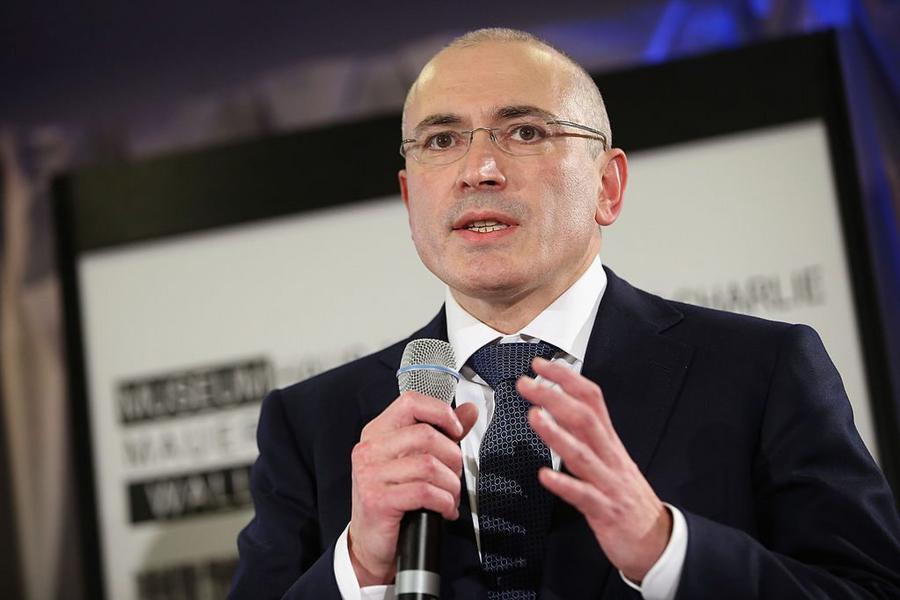
Mikhail Khodorkovsky / Sean Gallup/Getty Images
Arrest and Trial
While initially one of the political in-crowd, Khodorkovsky butted heads with Russian president Vladimir Putin, who had Khodorkovsky arrested in 2003 and charged with fraud. Not only did this affect Khodorkovsky, but also the Yukos oil company, which experienced a sharp collapse following the freezing of its shares. Khodorkovsky stood trial for his alleged crimes and, in May 2005, was found guilty and sentenced to nine years in prison. While serving his sentence, he was further charged with embezzlement and money laundering, and his sentence was extended. Only after Hans-Dietrich Genscher lobbied for his release did President Putin pardon Khodorkovsky, releasing him from jail in December 2013.
Khodorkovsky’s trial and sentencing were highly criticized abroad by the foreign press and governments, many of whom were concerned that his punishment was politically motivated. He filed several applications with the European Court of Human Rights, alleging multiple human rights violations committed by Russia. While the court did find that several violations had been committed, it ultimately ruled that the trial and arrest were not politically motivated.
Upon his release from prison, Khodorkovsky left Russian and was granted residency in Switzerland, and then he moved to London in 2015. While his wealth decreased significantly following the scandal of his arrest and time in prison, he was still a wealthy man by any margin, and his wealth increased as he made the move to London.
Open Russia
Khodorkovsky had originally launched the organization Open Russia in the early 2000s with the purpose of creating a foundation to strengthen the civil society of Russia. He relaunched Open Russia in 2014 as a nationwide community platform, much to the displeasure of President Putin and the Kremlin.
The organization advocates for independent media, the rule of law, political education, and greater support for political prisoners. They hope to eventually introduce sweeping reforms to Russia, including those aimed at law enforcement and elections. Khodorkovsky has said he hopes Open Russia can be a conduit through which a constitutional conference can be achieved to direct power away from the office of the presidency and towards the legislature and judiciary.
- One Minute He Was The Richest Person In Russia. The Next Day He Was Sent To A Siberian Prison. The Real Life Nightmare Of Mikhail Khodorkovsky
- Russian Government Ordered To Pay $50 Billion Settlement To Plundered Oil Company Shareholders. But Will They Pay?
- Bill Browder Net Worth
- Alexei Navalny Net Worth
- Mikhail Gorbachev Net Worth
- The Absolutely Incredible Life And Death Of The Original Russian Oligarch, Boris Berezovsky
One Minute He Was The Richest Person In Russia. The Next Day He Was Sent To A Siberian Prison. The Real Life Nightmare Of Mikhail Khodorkovsky
ByAmy Lamareon July 7, 2025inArticles›Entertainment
Picture this: The year is 2003, and you’re the richest person in Russia and the 16th richest person in the world thanks to your $15 billion net worth. One day, you wake up feeling pretty good about life. The very next day, you wake up in a Siberian prison.
You stay in that prison, not for a week or a few months. You rot there for the next 10 years .
During that horrible decade, your wealth evaporates into the hands of your arch enemy. Sound too unbelievable to be a true story? It almost sounds like a really bad nightmare. Well, unfortunately, this is exactly what happened to former Russian business tycoon Mikhail Khodorkovsky . His only crime? He dared to be a capitalist and was a vocal critic of Vladimir Putin …
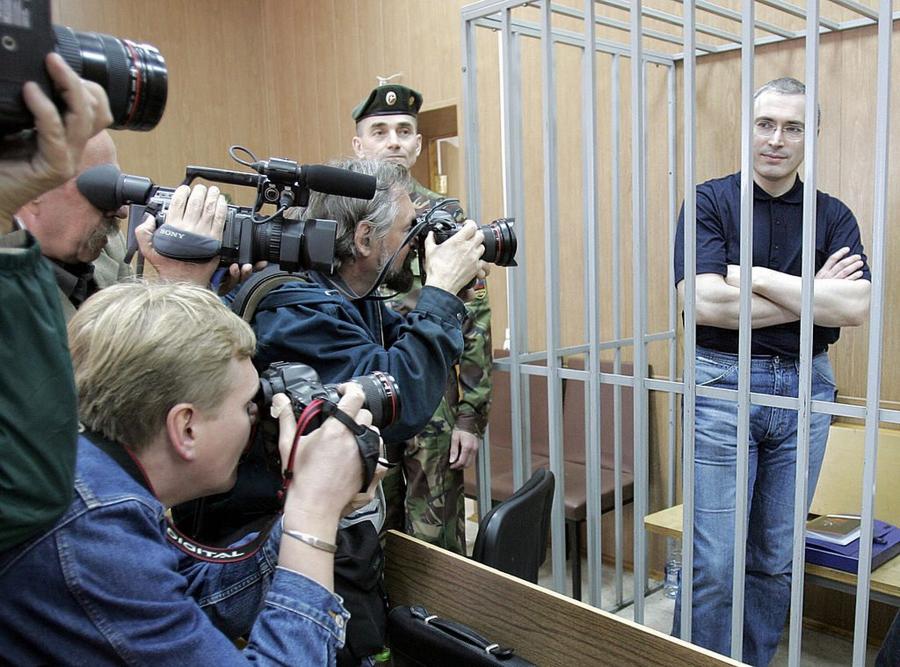
Mikhail Khodorkovsky / TATYANA MAKEYEVA/AFP/Getty Images
The Rise of a Reluctant Capitalist
Mikhail Khodorkovsky was born on June 26, 1963, in Moscow to two chemical engineers. Raised in a modest two-room apartment, he showed early signs of ambition. As a student, he joined the Communist Youth League (Komsomol) and began importing computers under its banner, exploiting a loophole that allowed him to convert administrative rubles into cash. In 1986, he earned a degree in chemical engineering from the Mendeleev Moscow Institute of Chemistry and Technology.
With Mikhail Gorbachev’s perestroika reforms came opportunity. In 1986, Khodorkovsky opened a small café.
A year later, he co-founded Bank Menatep, one of Russia’s first private banks. He used the bank to fund import-export ventures and amass capital while the old Soviet guard still viewed entrepreneurship as suspect. As he would later recall:
" Many years later I talked with people and asked them, why didn’t you start doing the same thing? Why didn’t you go into it? Because any head of an institute had more possibilities than I had, by an order of magnitude. They explained that they had all gone through the period when the same system was allowed. And then, at best, people were unable to succeed in their career and, at worst, found themselves in jail. They were all sure that would be the case this time, and that is why they did not go into it. And I" —Khodorkovsky lets out a big, broad laugh at the memory — “I did not remember this! I was too young! And I went for it. "
Mikhail Khodorkovsky / Sean Gallup/Getty Images
The Yukos Windfall
Khodorkovsky’s major breakthrough came in the early 1990s. During Russia’s chaotic transition to capitalism, state assets were sold off at fire-sale prices. He used Menatep to acquire shares in dozens of companies. In 1995, Menatep acquired the debt-ridden oil giant Yukos for just $300 million , while taking on $3.5 billion in liabilities.
It was a stunning deal. Yukos, anchored by Siberian oil fields, quickly became one of the largest and most profitable companies in post-Soviet Russia. Under Khodorkovsky’s leadership, it modernized operations, boosted output, and attracted foreign investment. By the early 2000s, Yukos was pumping more than a million barrels of oil per day.
Khodorkovsky’s fortune soared. By 2004, his empire gave him a net worth of $15 billion . That made him the richest person in Russia and the 16th richest person on earth. Life was good. But his growing wealth—and growing independence—was making the Kremlin uneasy.
Crossing Putin
Unlike many oligarchs who kept a low profile, Khodorkovsky spoke openly about corruption in Russia. He funded opposition political parties and independent media. In February 2003, during a televised meeting at the Kremlin, he confronted Vladimir Putin directly, accusing senior officials of taking bribes. It was a bold move—and a fatal one.
On October 25, 2003, Khodorkovsky was arrested aboard his private jet at a Siberian airport. Officially, he was to be questioned as a witness. In reality, he was charged with tax evasion, fraud, and embezzlement. The state quickly froze Yukos’s shares and launched a campaign that gutted the company’s value.
In 2005, Khodorkovsky was convicted and sentenced to nine years in prison. A second conviction followed in 2010 for embezzlement and money laundering. Critics and human rights groups widely viewed both trials as politically motivated.
A Fortune Lost
While Khodorkovsky sat in a Siberian labor camp, his empire was dismantled. Yukos assets were auctioned off—mostly to state-run oil giant Rosneft—and his personal fortune evaporated. In 2005, he transferred his remaining Yukos stake to longtime associate Leonid Nevzlin for an undisclosed sum. At that point, the shares were essentially worthless.
In 2013, after a decade behind bars, Khodorkovsky was suddenly pardoned by Putin and released just months before the Sochi Winter Olympics. He was flown to Germany and has lived in exile ever since.
In 2014, a group of Yukos shareholders, including Nevzlin, won a $50 billion arbitration award against the Russian state for the illegal seizure of the company. Khodorkovsky declined to participate in the suit and said he would not benefit from the judgment.
A Symbol of Risk
Khodorkovsky’s downfall remains a chilling precedent in Russia’s modern history. His arrest sent a message to other oligarchs: Stay out of politics, or risk losing everything. His story gained new relevance in July 2025 when Russian billionaire Konstantin Strukov— net worth $2 billion— was caught attempting to flee the country on his private jet . His assets were frozen and his passport canceled amid a Kremlin-driven nationalization effort.
As Khodorkovsky himself once joked, the only reason he built an empire in the first place was because he didn’t remember what had happened to others before him.
- Mikhail Khodorkovsky Net Worth
- Russian Government Ordered To Pay $50 Billion Settlement To Plundered Oil Company Shareholders. But Will They Pay?
- Is Vladimir Putin Secretly The Richest Person In The World?
- Basketball Billionaire Facing Full Court Press From Kremlin
- Vladimir Putin Has Set His Sights On Bringing Down Another Russian Billionaire
- These Five Billionaires Went From Having 10 Figure Bank Accounts To Being Flat Broke. Ouch.
