In 2007, Jensen Huang Donated $12.6 Million Worth Of NVIDIA Shares To His Foundation… Those Shares Have Increased In Value Just Slightly
ByBrian Warneron October 29, 2025inArticles›Billionaire News
NVIDIA was founded in 1993 by Jensen Huang , Chris Malachowsky, and Curtis Priem. Six years later, on January 22, 1999, the company went public. At the end of the trading day at IPO, NVIDIA’s market cap was $ 550 million .
Over the next several years, NVIDIA’s stock rose steadily as its graphics processors became the standard for high-performance PC gaming. The company’s market cap topped $1 billion in January 2000, doubled a few months later, and reached about $3.5 billion before the dot-com bubble burst. In early 2002, after briefly nearing $7 billion in value, NVIDIA’s momentum stalled amid the broader tech crash and an SEC inquiry into its accounting practices. A slowdown in PC demand and a poorly timed product transition further dented investor confidence. By September 2002, NVIDIA’s market cap had plunged to roughly $870 million. The company gradually regained its footing thanks to new GPU architectures, growing demand for 3D gaming, and major console partnerships with Microsoft’s Xbox and Sony’s PlayStation 3. By 2004, NVIDIA had stabilized around the $2–3 billion range, and by 2006, it surged past $10 billion for the first time. In mid-2007, the company’s value reached roughly $15 billion, cementing its dominance in graphics technology.
With NVIDIA thriving once again and its stock climbing to new highs, in the middle of 2007, Jensen Huang and his wife, Lori, began reflecting on how to use their wealth for a greater purpose. So, that summer, they established the Jen-Hsun and Lori Huang Foundation. They seeded their foundation with an initial donation of 370,000 NVIDIA shares . At the time (before several future stock splits), those shares were worth $12.6 million .
Compared to the multi-billion-dollar Silicon Valley foundations launched with Hewlett-Packard, Intel, eBay, Dell, and Google fortunes, $12.6 million was a pittance. Probably not enough to cover salaries at Bill & Melinda Gates ’ $33 billion foundation.
Fast forward to today, and, as you may have heard, NVIDIA is no longer a niche gaming graphics card company. It’s the most valuable company in the world with a market cap that just crossed $5 trillion today . Along the way, the Jen-Hsun and Lori Huang Foundation has grown from a modest little charity no one had heard of, into something much, much, much, much bigger.
Here’s a photo of Jensen with his family in May 2007, right around the time they established their foundation (from left to right, daughter Madison, wife Lori, Jensen, and son Spencer):
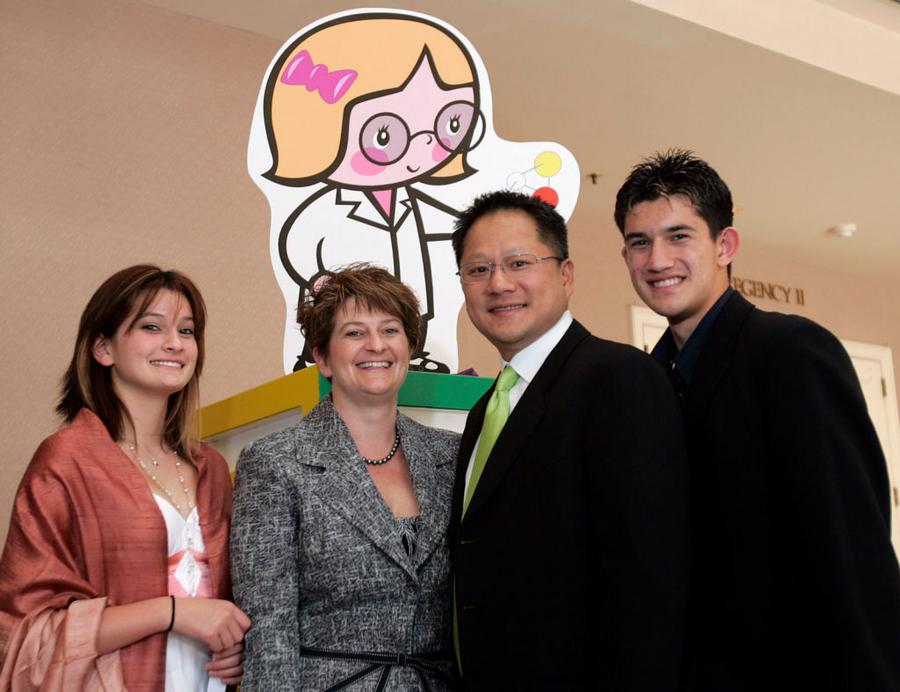
Jensun with his family, Madison, Lori, and Spencer in 2007 (Thu Hoang Ly/Mercury News) (Photo by MediaNews Group/The Mercury News via Getty Images)
From Modest Gift To Mega Foundation
To reiterate, the Jen-Hsun and Lori Huang Foundation was quietly seeded in 2007 with a donation of 370,000 NVIDIA shares, then worth around $12.6 million .
As you know, over the next 17 years, but especially in the last few years, NVIDIA’s stock has gone absolutely parabolic. During that period, the company executed three stock splits, turning the Huangs’ original 370,000 shares into roughly 14.8 million today. At NVIDIA’s current $5 trillion market capitalization, that initial donation alone would be worth $3.1 billion—enough to rank the foundation among the 50 largest in the world. But wait. There’s more!
The Huangs have continued to add to their foundation’s holdings over the years. In June 2025, for example, they contributed another 440,000 shares, valued at approximately $60 million at the time of transfer.
According to its latest filing, as of the end of 2023, the foundation held 68.5 million shares of NVIDIA. If you add the 440,000 shares from the June 2025 transfer, it’s probably safe to call it 69 million today. At today’s $5 trillion valuation, those 69 million shares are now worth around…
$14.35 billion
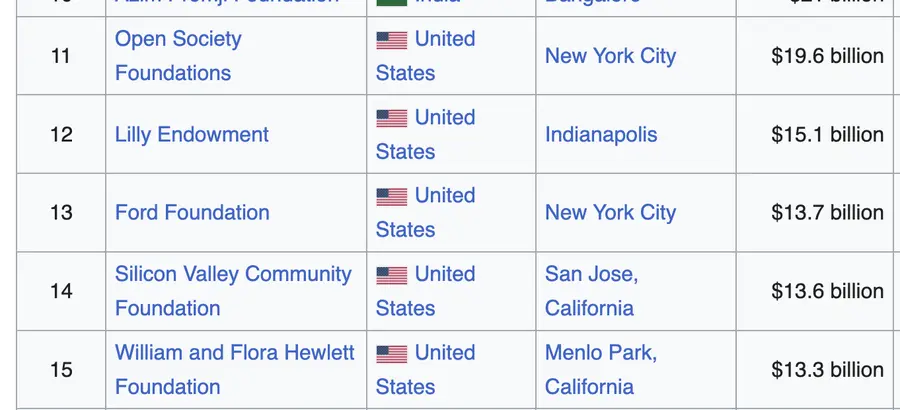
That’s enough to rank the Jen-Hsun and Lori Huang Foundation as the 12th largest charitable foundation on the planet , ahead of the Ford Foundation ($13.7 billion) and below the Lilly Endowment ($15.1 billion).
Yet if you look at Wikipedia’s ranking of the world’s largest foundations , you will not find the Jen-Hsun and Lori Huang Foundation listed. Not between Ford and Lilly. Not lower in the rankings with an outdated number. The foundation is not listed at all. The reason is simple: the Jen-Hsun and Lori Huang Foundation keeps a remarkably low profile. It has no website, no public address, and no digital footprint beyond mandatory filings. A LinkedIn search for employees turns up nothing. For comparison, the Ford Foundation employs 423 full-time people. The Gates Foundation employs over 2,000 people. The Jen-Hsun and Lori Huang Foundation? Employs ZERO people.
Where the Money Is Going
Like many modern tech philanthropists, the Huangs have relied heavily on donor-advised funds (DAFs) as an initial vehicle for giving. In 2023, roughly 77% of the foundation’s disbursements—about $46 million—went to a Schwab-managed DAF. These accounts are popular among wealthy donors because they allow for an immediate tax deduction while postponing the actual deployment of funds. DAFs are not required to distribute assets on any schedule and are not obligated to publicly disclose where their eventual grants go, which makes them a convenient but opaque tool for large-scale philanthropy.
The Huangs have also made several major direct gifts from their foundation. In 2022, they pledged $50 million to Oregon State University, their alma mater, to fund a new research and education complex. In early 2025, they announced a $22.5 million grant to the California College of the Arts, aimed at strengthening the school’s endowment and academic programs. Other public records show additional support for institutions like Stanford University and select community and mental health organizations.
As the foundation’s assets continue to grow, so too will the required level of annual giving. U.S. law mandates that private foundations distribute at least 5% of their assets each year, whether through direct grants or DAF contributions. Based on the company’s 2024 average market cap, the foundation likely had to distribute around $350 million this year to meet its 5% minimum. Assuming NVIDIA maintains its current $5+ trillion market cap, next year the foundation will be required to distribute $700 million!
For most tech billionaires, philanthropy is a stage performance — press releases, summits, and splashy initiatives. For Jensen and Lori Huang, it’s a quiet calculation. Their foundation has no fanfare, yet it now rivals the largest charitable endowments on earth. And all of it traces back to a single 2007 stock donation that grew — like NVIDIA itself — beyond anything Silicon Valley could have imagined.
BTW, What Happened To His Co-Founders?
If you recall the first sentence of this article: " NVIDIA was founded in 1993 by Jensen Huang, Chris Malachowsky, and Curtis Priem." When NVIDIA went public:
- Jensen owned 15% of the company
- Chris owned 10%
- Curtis owned 12.8%
Today, Jensen owns 3.5% of NVIDIA, which at today’s $5 trillion market cap, gives him a net worth of $175 billion. He is the #8 richest person on earth .
Chris Malachowsky still works at the company, holding the title of NVIDIA Fellow and remaining deeply involved in research and high-performance computing initiatives. His net worth is not known, but he is not a confirmed billionaire. If he still owned his 10% stake, today he would be worth $500 billion.
Curtis Priem walked away two decades ago and proceeded to give nearly all of his fortune to his alma mater, Rensselaer Polytechnic Institute. After transferring most of his NVIDIA stock to a charitable foundation in 1999, Priem went on to donate more than $275 million to RPI—including a $40 million performing-arts center that bears his name and a $95 million pledge to bring an IBM Quantum System One computer to campus. At one point, he owned 12.8% of NVIDIA. If he still owned that much, today he would be worth $650 billion . According to a November 2023 Forbes profile of Curtis, at that point, he was worth around $30 million.
- NVIDIA’s Long-Lost Co-Founder Could Have Been Worth $650 Billion Today, But He Donated All Of His Shares To Charity Back In 1999
- Are We In A Massive AI Bubble? How Does NVIDIA Today Compare To The 1990s Dotcom Bubble?
- Larry Ellison Has The Clearest Path To Becoming The World’s First Trillionaire
- The 20 Largest Private Foundations In the US: And Where Their Money Came From
- Today Microsoft’s Market Cap Hit $4 Trillion. Bill Gates Should Be Worth $1.4 Trillion. Instead, He Took Warren Buffett’s Horrendous Advice
- Larry Ellison Just Leapfrogged Jeff Bezos To Become The World’s Third Richest Person. Next Stop, World’s First Trillionaire?
Larry Ellison Just Leapfrogged Jeff Bezos To Become The World’s Third Richest Person. Next Stop, World’s First Trillionaire?
ByBrian Warneron June 13, 2025inArticles›Billionaire News
This week, Larry Ellison’s net worth increased by $34 billion in roughly 48 hours, thanks to a massive rally in Oracle’s stock price following a blowout earnings report and rising investor confidence in the company’s AI capabilities.
Shares of Oracle soared 13% on Thursday and another 7% on Friday, closing at a record high of approximately $215. The surge added over $100 billion to Oracle’s market capitalization and pushed Ellison’s personal fortune to $235 billion, up from around $201 billion earlier in the week.
That gain vaulted Ellison into the third spot among the world’s richest people, leapfrogging Jeff Bezos and now trailing only Elon Musk and Mark Zuckerberg.
Current Top 5 Richest People in the World :
- Elon Musk – $368 billion
- Mark Zuckerberg – $241 billion
- Larry Ellison – $235 billion
- Jeff Bezos – $234 billion
- Bill Gates – $180 billion
For Ellison, this marks not only a financial milestone but also a historic turning point in one of the tech world’s most iconic rivalries.
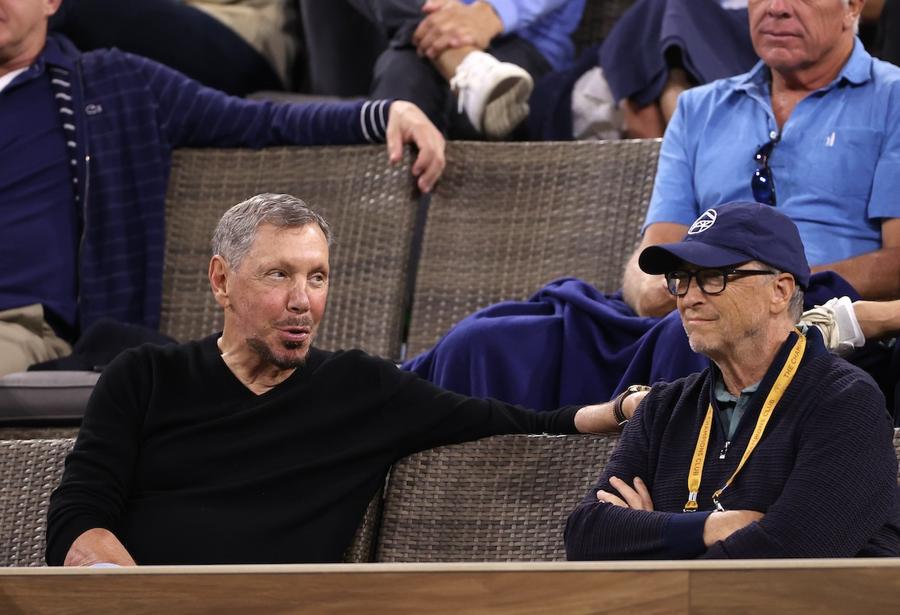
Larry and Bill (Photo by Sean M. Haffey/Getty Images)
Oracle went public on March 12, 1986 — just one day before Microsoft’s IPO . From that moment forward, Ellison and Bill Gates were locked in a decades-long battle for software dominance. While Oracle specialized in enterprise databases and cloud infrastructure, Microsoft exploded into consumer and enterprise software, capturing a far larger share of the market, and for most of their careers, Gates dramatically outpaced Ellison in terms of wealth.
As you probably know, Bill Gates was the richest person on the planet, with only a few brief interruptions, from 1997 until 2017. During those years, Larry was largely out of the spotlight in terms of wealth rankings.
Even a decade ago, Ellison’s net worth hovered around $30–40 billion, while Gates stood at roughly $80 billion.
Much of the difference comes down to how the two men managed their equity. Gates, who owned 45% of Microsoft at IPO, gradually sold off nearly all of it over the decades. His current stake in Microsoft is down to around 1.4% , and while that was a wise move in terms of diversification and philanthropy, it limited his exposure to the company’s staggering growth. With Microsoft now worth $3.5 trillion, a hypothetical 30% stake would be worth $1.05 trillion — enough to make Gates the world’s first trillionaire .
Ellison, by contrast, never let go of the wheel. Four decades after the IPO, he still owns roughly 41% of Oracle. As Oracle’s market cap climbed to $600 billion for the first time this week, Ellison’s patience and concentration have paid off in dramatic fashion.
What Would It Take to Top Marky Mark & The Zucky Bunch?
To surpass Mark Zuckerberg and become the world’s second-richest person (assuming Zuckerberg’s net worth holds steady at $241 billion), Larry Ellison would need Oracle’s stock to climb from $215 to around $220 per share, or its market cap to increase by roughly $15 billion. A 2.5% increase in Oracle’s stock would do the trick. Very possible — maybe even by Monday.
Could Larry Ellison Become a Trillionaire?
Believe it or not, that’s not entirely out of the question. At a 41% ownership stake, Ellison’s net worth rises roughly $41 billion for every $100 billion added to Oracle’s market cap. To reach $1 trillion, Ellison would need his Oracle shares alone to be worth that amount — which would require the company’s market cap to hit about $2.44 trillion.
That’s more than four times its current size — but not unthinkable. Oracle’s market cap was just $60 billion in 2005 and $180 billion in 2015. On Friday, Oracle’s market cap ended at $600 billion for the first time. As further evidence, Microsoft, Apple, and Nvidia have already crossed the $3 trillion threshold, and Oracle is aggressively positioning itself as a key player in AI infrastructure, a sector that could see exponential growth in the coming years.
For now, Ellison is the third richest person in the world, and perhaps the greatest living example of what patient, long-term ownership can achieve.
Disclosure: The author owns shares of Oracle Corporation in a retirement account. This article is for informational/entertainment purposes only and should not be considered financial or investment advice.
- Billionaire Larry Ellison Is Raking In The Cash On His $1 Billion Tesla Bet
- Larry Ellison Net Worth
- Oracle Founder Larry Ellison Lost More Than $3 Billion In One Day Last Week
- Larry Ellison Reveals His $1 Billion Stake In Tesla
- The Incredible Rags To Insane Riches Story Of Oracle Founder Larry Ellison
- Billionaire Larry Ellison Closes 97% Of Hawaiian Island Lanai For Extreme Renovations
